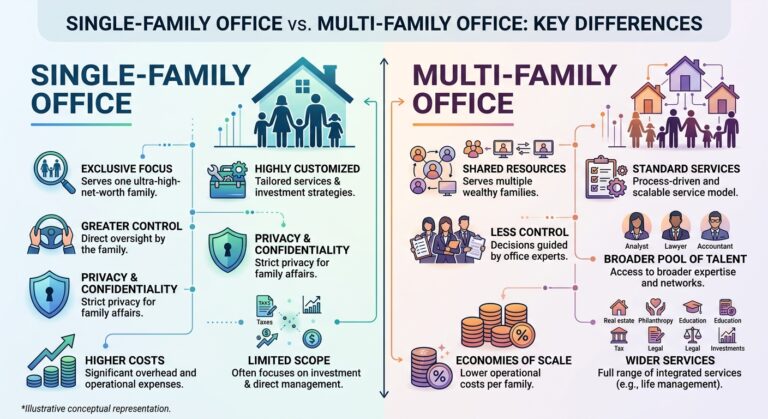

Multi-Family Office Pros and Cons for HNW Families
Weigh the pros and cons of a multi-family office for high-net-worth families. Learn about lower costs, shared expertise, and professional investment management, versus less customization and privacy, to decide if a multi-family office suits your wealth.
Weighing the multi-family office pros and cons is one of the most consequential choices a wealthy family makes after a liquidity event, an inheritance or a business sale. A multi-family office (MFO) offers a full team of specialists without the burden of building one, but it also means sharing the firm with other clients and accepting a standard way of working. This guide lays out the benefits, the downsides, the likely cost and the questions that separate a good provider from a weak one.
If you are still comparing models, our article on single-family office vs. multi-family office covers the structural differences. For background on the basics, see what a family office is.
Quick Answer: Multi-Family Office Pros and Cons at a Glance
| Pros | Cons |
|---|---|
| A bench of specialists from day one | Advisors are not dedicated to one family |
| Lower cost than building your own office | Less customization than a bespoke setup |
| Fast launch, often within weeks | Limited control over day-to-day processes |
| Shared overhead and institutional access | Your information sits inside a multi-client firm |
| Lower wealth threshold, often from about $25 million | Possible conflicts of interest, including fee incentives |
What Is a Multi-Family Office?
Before the multi-family office pros and cons make sense, you need the definition: a multi-family office serves several wealthy families at once. Cresset describes it as a provider of private wealth management that combines tax and estate planning, risk management, investment management, trusteeship, lifestyle and concierge services. The firm spreads its staff, technology and compliance costs across its clients, which is why it can offer broad support at a lower price than a private team would cost. Cresset puts the typical client threshold at a net worth above $25 million, while Morgan Lewis places MFO suitability between $25 million and $150 million in investable assets.
Multi-Family Office Pros: The Advantages
1. Instant Access to Specialists
Asora highlights “a full bench of specialists on day one” across investment, tax, estate planning and governance. Cresset makes a similar point: you get a team of specialists, whereas a typical wealth manager is often a lone generalist. For a family facing a complicated sale or a cross-border move, that depth can matter more than any single investment decision.
2. Lower Cost Than a Single-Family Office
Costs are shared, so each family pays for a slice of the infrastructure. Brown Brothers Harriman (BBH) states that a family with $50 million or $100 million can likely receive most of the services of a private office for less by hiring a multi-family office, which benefits from greater scale. Cresset lists lower costs and economies of scale among the main benefits.
3. Faster Launch
Building a private office takes months. Asora says an MFO can be operational within weeks, because the systems, policies and staff already exist. That speed helps families who need structure quickly after receiving a large inflow of cash.
4. Institutional Access and Diverse Perspectives
Asora notes that pooled assets can earn better terms with institutional managers. Cresset adds that working with multiple advisors exposes the family to different viewpoints and to practices observed across many other clients.
5. A Lower Entry Point
Because the firm supports many clients, the minimum is far below what a dedicated team requires. Both Cresset and Asora cite roughly $25 million, and Asora says some modular services start lower.
Multi-Family Office Cons: The Disadvantages
1. Shared Attention
Among the multi-family office cons, Cresset lists a core drawback: advisors are not exclusively dedicated to one family. Your relationship manager has other clients, and in busy periods you compete for time.
2. Less Customization and Control
Asora warns that the firm sets its standard processes and investment approaches, so families cannot run day-to-day operations or expect a fully bespoke arrangement. You must be comfortable delegating and trusting the team rather than overseeing every detail.
3. Privacy Considerations
Asora points out that although MFOs protect confidentiality, your data lives inside a multi-client firm instead of a private structure. Ask how the firm separates client records and who inside the organization can see them.
4. Business Incentives and Conflicts of Interest
BBH observes that multi-family office fees cover a range of services but are also meant to create a profit, whereas a single-family office exists only to serve one family. Cresset states that “fiduciary obligation does not mean that Cresset has no conflicts of interest” and tells clients to review Form ADV Part 2A, the disclosure document registered advisers file. Cresset also mentions greater firm visibility and client recruitment efforts as a downside, since a growing firm is constantly pursuing new clients.
How Much Does a Multi-Family Office Cost?
The price depends on the fee model and the services included. Cresset lists the common structures below.
| Fee type | How it works |
|---|---|
| Asset-based | A percentage of assets, from 0.5% to 2% or more a year |
| Performance-based | A share of investment gains |
| Hourly | Charged for specific work, such as tax planning |
| Retainer | A flat, ongoing charge |
| Setup, transaction, custodian and administration | Additional one-time or recurring items |
Asora gives a narrower asset-based range of 0.5% to 1.5% and an example: a family with about $250 million might pay 0.5% to 1%, or roughly $1.25 million to $2.5 million a year, with staff costs included in the fee. A quick check confirms the arithmetic: 0.5% of $250 million is $1.25 million and 1% is $2.5 million.
Fees are the pro that turns into a con if you skip the fine print, so compare the full schedule, not only the headline rate. Our guide to family office fees explains how to convert every quote into a percentage and spot extra charges.
When the Multi-Family Office Pros and Cons Favor Hiring One
The multi-family office pros and cons tilt toward hiring one when several of these statements are true.
- You hold roughly $25 million to $150 million in investable assets.
- You want professional coverage quickly instead of waiting months to hire a team.
- Your needs are broad but not highly unusual.
- You are comfortable with a standardized process.
- You would rather avoid managing employees, payroll and compliance.
Morgan Lewis frames the decision differently from many price comparisons. It calls the choice “not primarily a cost decision, but rather a governance and complexity decision.” In other words, the number of entities, countries, generations and private investments in your life matters as much as your net worth.
When the Multi-Family Office Pros and Cons Point Elsewhere
The multi-family office pros and cons tilt the other way if these points describe your situation.
- You want full authority over investment selection and hiring.
- Your affairs are so specialized that a standard offering would need heavy customization.
- You hold more wealth than the firm typically serves, so you would have limited influence.
- You dislike the idea of your data and advice being handled within a larger organization.
Families with very large or unusual portfolios sometimes move to a single-family office or a hybrid model. The thresholds for that step are discussed in how much money you need to start a family office.
Multi-Family Office Pros and Cons Compared With Other Options
| Option | Strength | Weakness |
|---|---|---|
| Multi-family office | Broad services, shared cost | Shared attention, less control |
| Single-family office | Full control and privacy | High fixed cost and hiring burden |
| Hybrid model | Control over key decisions with outside help | Needs clear division of duties |
| Private bank and independent advisors | Simple and familiar | Coordination falls on the family |
Morgan Lewis notes that external providers typically account for 25% to 28% of a family office’s cost, which shows how common it is to buy expertise from outside. It also advises reassessing the model every three to five years or after a major event.
How to Choose a Multi-Family Office
Use this checklist to test the multi-family office pros and cons against each provider you interview.
- Ask about independence. Does the firm sell its own products, and how is it paid?
- Read the regulatory filings. Review Form ADV Part 2A for conflicts and fee details.
- Request a complete fee schedule. Include performance, setup, custody and administration charges.
- Meet the actual team. Find out who will serve you and how many families each person handles.
- Check what is included. Confirm whether tax, legal, reporting and governance support are in the fee.
- Test for flexibility. Ask how much customization the firm permits and how it handles special requests.
- Ask about exit terms. Learn how assets and records transfer if you leave.
- Plan a review date. Revisit the arrangement as your wealth and complexity change.
Common Mistakes When Weighing Multi-Family Office Pros and Cons
- Choosing on the headline fee alone. A lower percentage may cover fewer services.
- Skipping the conflict review. Product incentives can shape advice.
- Assuming all MFOs are alike. Cresset and Asora describe different service menus and fee ranges.
- Expecting a private office. A shared firm will always involve standardized processes.
- Never reviewing the arrangement. Needs change, and so can the best model.
Frequently Asked Questions
What are the main multi-family office pros and cons?
The main advantages are access to specialists, lower cost than a private office, faster setup and shared overhead. The main drawbacks are shared attention, less customization, limited control and possible conflicts of interest.
What is the minimum wealth for a multi-family office?
Cresset cites a net worth above $25 million, and Asora puts the usual minimum near $25 million, though some modular services start lower.
How much do multi-family offices charge?
Cresset reports 0.5% to 2% or more of assets for asset-based fees, while Asora cites 0.5% to 1.5%. Some firms add performance, hourly, retainer or setup charges.
Is a multi-family office better than a single-family office?
Not always. For families with $50 million to $100 million, BBH says an MFO can likely deliver most services for less. Very large or highly complex families may prefer the control of a dedicated office.
Are multi-family offices fiduciaries?
Many are registered investment advisers with a fiduciary duty, but Cresset notes that this does not remove every conflict of interest. Review the firm’s Form ADV.
How fast can you start with a multi-family office?
Asora says an MFO can be operational within weeks, compared with months to a year for a private office.
Educational content only; this article is not financial, legal or tax advice. Provider terms, fees and regulations vary, so confirm details with qualified professionals before selecting a firm.
Sources
- Cresset, “What Is a Multi-Family Office?” (last updated August 3, 2026) – https://cressetcapital.com/post/what-is-a-multi-family-office/
- Asora, “Single-Family Office vs. Multi-Family Office” (July 21, 2026) – https://www.asora.com/blog/single-family-office-vs-multi-family-office
- Morgan Lewis, “Control, Cost and Complexity: Finding the Right Family Office Model” (July 2026) – https://www.morganlewis.com/pubs/2026/07/control-cost-and-complexity-finding-the-right-family-office-model
- Brown Brothers Harriman, “Seven Considerations Before Creating a Family Office” (May 8, 2025) – https://www.bbh.com/us/en/insights/private-banking-insights/seven-considerations-before-creating-a-family-office.html