
How to Start a Family Office: Step-by-Step Guide
How to Start a Family Office: Step-by-Step Guide
Once a family has decided that building a dedicated family office makes sense — usually somewhere north of $100 million in investable assets — the next question is practical: how do you actually build one from scratch? Unlike opening a brokerage account or hiring a single advisor, launching a family office means creating an entire private institution, with its own legal structure, staff, and governance.
Here’s how it’s typically done.
Step 1: Define the Family’s Goals and Values First
Before hiring anyone or setting up a single legal entity, the most important groundwork is defining what the family actually wants the office to accomplish. This usually means answering questions like:
- Is the priority pure investment growth, wealth preservation, or a mix of both?
- How involved should family members be in day-to-day decisions versus delegating fully to professionals?
- Is philanthropy a core part of the mission, or a separate consideration?
- How many generations is this being built to serve?
Skipping this step is one of the most common reasons family offices underperform — a office built without clear goals ends up reactive rather than strategic.
Step 2: Choose the Legal and Organizational Structure
Family offices are typically set up as a separate legal entity — most commonly an LLC or a private trust company, depending on jurisdiction and tax considerations. This step usually requires:
- Selecting the jurisdiction (based on tax treatment, regulatory environment, and where the family’s assets are concentrated)
- Working with legal counsel to draft governance documents
- Deciding whether the office will also serve as trustee for family trusts, or whether that role stays separate
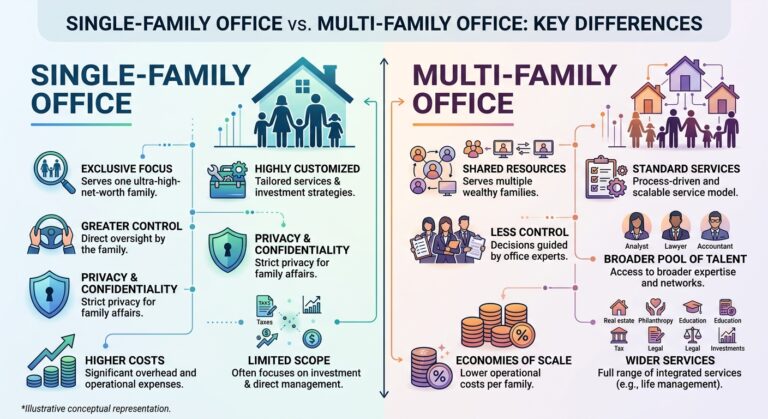
Step 3: Decide on Single-Family vs. Multi-Family
Even families with the resources to build a single-family office sometimes start by testing the waters with a multi-family office first, to clarify exactly which services they value most before committing to the cost of a dedicated build-out.
Step 4: Build the Core Team
A lean single-family office typically starts with three key hires:
- Chief Investment Officer (CIO) — sets and executes investment strategy across asset classes
- Chief Operating Officer / General Counsel — manages legal structure, compliance, and daily operations
- Family Office Director — the point of contact for the family, coordinating everything else
From there, additional specialists (tax attorneys, philanthropic advisors, real estate managers) are added as needs grow.
Step 5: Set Up Investment Infrastructure
This includes selecting custodians for holding assets, establishing relationships with outside fund managers for private equity and alternative investments, and implementing portfolio reporting systems that give the family real-time visibility into their holdings.
Step 6: Establish Governance and Family Communication Systems
Many family offices formalize decision-making through a family constitution or governance charter — a document outlining how decisions get made, how conflicts are resolved, and how future generations will be brought into the process. Regular family meetings (often quarterly or annually) become a structured part of how the office operates.
Step 7: Build Out Estate and Succession Planning
Trusts, wills, and other estate structures are typically set up in close coordination with the family office’s legal team, ensuring the office’s day-to-day management aligns with the long-term plan for how wealth eventually transfers to the next generation.
Step 8: Plan for Ongoing Evaluation
A family office isn’t a «set it and forget it» structure. Most families schedule periodic reviews — often annually — to assess investment performance, staff effectiveness, and whether the office’s structure still matches the family’s evolving needs.
Realistic Timeline
Building a fully operational single-family office from scratch typically takes 6–18 months, depending on the complexity of the family’s assets, how quickly senior staff can be recruited, and how many jurisdictions are involved.
The Bottom Line
Starting a family office is less like hiring a financial advisor and more like founding a company — it requires clear goals, the right legal structure, a strong core team, and a governance framework that can hold up across generations. Families that rush this process, or skip the values-and-goals step, are the ones most likely to end up with an office that doesn’t actually serve their long-term interests.