
What Is a Family Office and How Does It Work?
What Is a Family Office and How Does It Work?
If you’ve spent any time researching how the ultra-wealthy manage their money, you’ve probably come across the term «family office.» Unlike a bank, a wealth manager, or a financial advisor, a family office is something more comprehensive — and more private. It’s the closest thing to a personal CFO, legal department, and household management team rolled into one, built exclusively to serve a single family’s wealth.
In this guide, we’ll break down exactly what a family office is, how it works, what it actually does day to day, and who realistically needs one.
What Is a Family Office?
A family office is a private organization set up to manage the financial and personal affairs of a wealthy family. Rather than working with dozens of separate professionals — a broker here, an accountant there, an estate lawyer somewhere else — a family office centralizes all of it under one roof, staffed by professionals who answer to the family alone.
The concept isn’t new. The first modern family offices trace back to the late 1800s, when industrial fortunes (the Rockefellers being the most famous example) grew too large and too complex for standard banking relationships to handle. Today, family offices exist for a much broader range of wealth levels, from multi-generational dynasties to first-generation entrepreneurs who’ve recently sold a business.
What Does a Family Office Actually Do?
A family office’s responsibilities typically fall into five core areas:
Investment management. Overseeing the family’s portfolio across public markets, private equity, real estate, and alternative assets — often with far more flexibility and risk tolerance than a traditional retail brokerage account allows.
Tax and legal coordination. Working with (or directly employing) tax attorneys and accountants to structure the family’s assets efficiently and stay compliant across multiple jurisdictions, if applicable.
Estate and succession planning. Structuring trusts, wills, and governance documents so that wealth transfers to the next generation smoothly — and doesn’t get eroded by taxes, disputes, or mismanagement.
Philanthropy management. Many family offices run the family’s charitable foundation, handling grant-making, impact reporting, and giving strategy.
Lifestyle and administrative support. This is the part people rarely talk about publicly: property management, private aviation logistics, household staffing, insurance for high-value assets (art, yachts, jewelry), and even personal security.
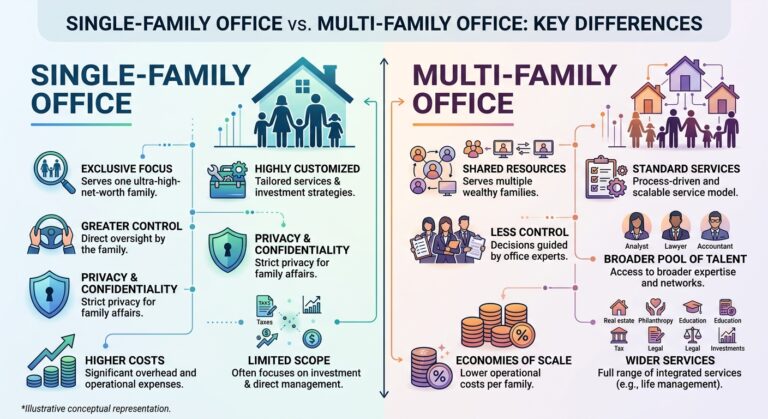
Single-Family Office vs. Multi-Family Office
There are two main structures:
A single-family office (SFO) serves one family exclusively. It’s the most private and customized option, but it’s also the most expensive to run — which is why it typically only makes sense once a family has well over $100 million in investable assets.
A multi-family office (MFO) serves several unrelated wealthy families at once, sharing the cost of staff, infrastructure, and expertise. This makes many of the same services accessible to families with $10–$50 million in assets, at a fraction of the cost of running a dedicated office.
How Much Money Do You Actually Need?
There’s no official minimum, but industry convention puts the threshold for a standalone single-family office somewhere around $100–$250 million in investable assets — below that, the fixed costs of hiring a full team (investment staff, legal counsel, accountants, operations) usually don’t justify themselves compared to outsourcing to a multi-family office or a top-tier wealth management firm.
How a Family Office Is Typically Structured
Most family offices are organized around three core roles:
- Chief Investment Officer (CIO) — oversees portfolio strategy and manages relationships with external fund managers
- Chief Operating Officer / General Counsel — handles legal structure, compliance, and day-to-day operations
- Family Office Director / Principal — often a trusted advisor to the family patriarch or matriarch, coordinating everything and reporting directly to the family
Larger offices add specialized staff: tax attorneys, philanthropic directors, real estate managers, and sometimes even household staff coordinators.
Family Office vs. Private Bank: What’s the Difference?
This is one of the most common points of confusion. A private bank serves many clients and earns money primarily through the products it sells you — investment funds, loans, insurance. A family office works for one family only, has no products to sell, and is compensated directly by the family (either through a flat operating budget or a management fee), which removes most of the conflict of interest that comes with a bank trying to cross-sell its own financial products.
The Bottom Line
A family office isn’t just «having a financial advisor» — it’s an entire private institution built around protecting, growing, and eventually transferring a family’s wealth across generations. For families with significant assets, the appeal isn’t just performance; it’s control, privacy, and having every part of a complex financial life coordinated by people who work exclusively for them.