
Single-Family Office vs. Multi-Family Office: Key Differences
Single-Family Office vs. Multi-Family Office: Key Differences
If you’re wealthy enough to be considering a family office, one of the first decisions you’ll face isn’t about investment strategy — it’s about structure. Do you build a dedicated team just for your family, or do you join a shared platform serving several families at once? The answer has major implications for cost, privacy, and control.
Here’s how the two models actually compare.
What Is a Single-Family Office (SFO)?
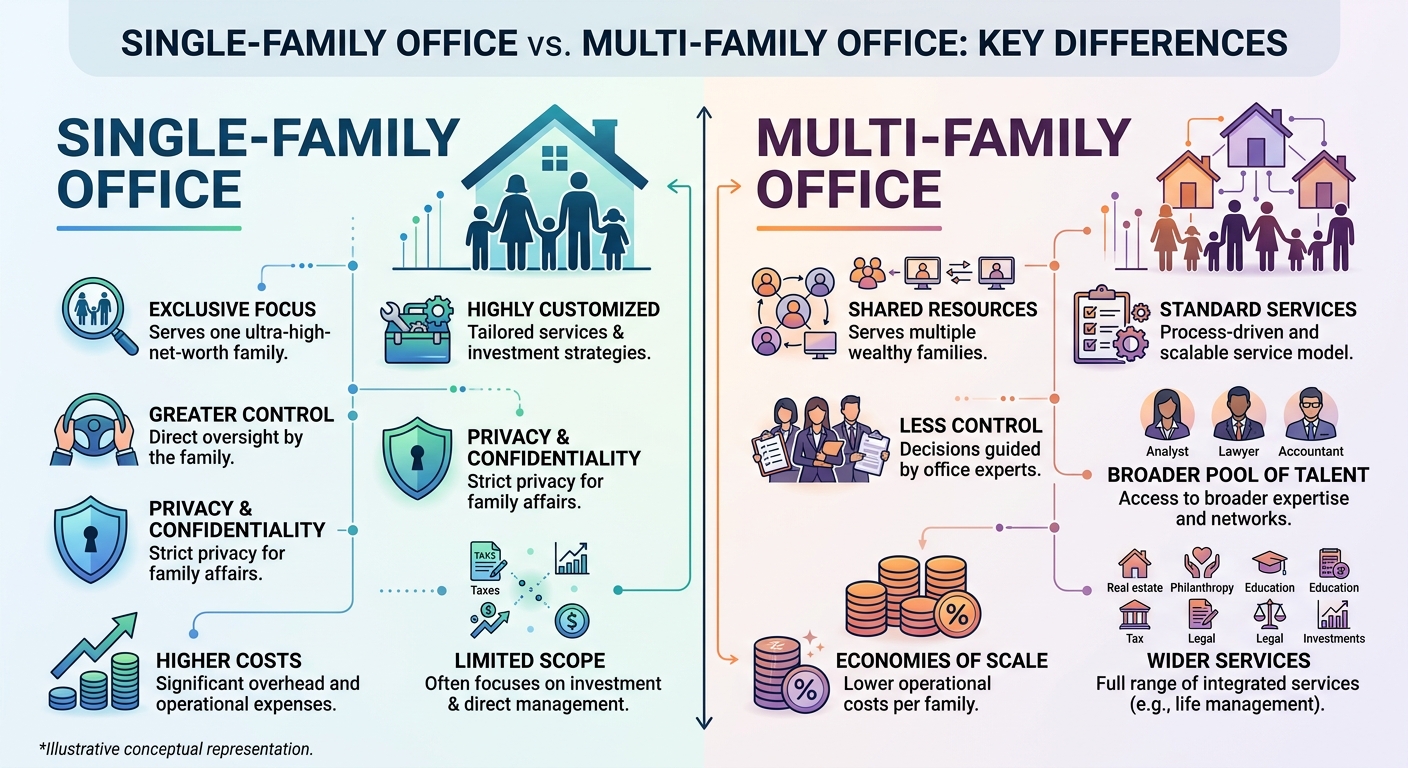
A single-family office exists to serve one family exclusively. Every advisor, analyst, and support staff member works for that family alone — there are no other clients, no shared priorities, and no conflicts of interest between families competing for the same team’s attention.
Advantages:
- Complete privacy — no other family ever sees your financial details, staff, or strategy
- Fully customized services, built around the family’s specific goals, values, and lifestyle needs
- Direct control over hiring, strategy, and governance
- Can extend beyond finance into deeply personal territory: household staffing, security, education planning for heirs
Drawbacks:
- Very expensive to run — annual operating costs typically range from $2–5 million or more, even before accounting for salaries of senior investment staff
- Requires significant scale to justify the overhead (generally north of $100–250 million in investable assets)
- Harder to attract and retain top-tier talent compared to firms managing billions across many clients
What Is a Multi-Family Office (MFO)?
A multi-family office serves multiple unrelated wealthy families under one roof, pooling resources to offer many of the same services at a lower cost per family. Think of it as a boutique private bank crossed with an independent advisory firm — client-first, but with shared infrastructure.
Advantages:
- Significantly lower cost of entry — accessible to families with $10–50 million in assets, rather than hundreds of millions
- Access to a broader bench of specialists (tax, legal, alternative investments) that would be unaffordable to hire in-house at a smaller scale
- Often has stronger negotiating power with external fund managers due to larger combined assets under management
Drawbacks:
- Less privacy — your advisors also work with other families, even if information is kept strictly confidential
- Services are more standardized; customization has limits
- Family priorities may occasionally compete for attention during busy periods (market volatility, tax season, etc.)
Key Differences at a Glance
| Factor | Single-Family Office | Multi-Family Office |
|---|---|---|
| Typical minimum wealth | $100M+ | $10–50M+ |
| Annual cost | $2–5M+ | Fee-based, often 0.25%–1% of AUM |
| Privacy | Maximum | High, but shared staff |
| Customization | Fully bespoke | Standardized, with some flexibility |
| Staff loyalty | Exclusive to one family | Shared across client families |
| Talent access | Limited by budget | Broader, shared specialist bench |
| Setup complexity | High (recruiting, legal entity, governance) | Low (join an existing firm) |
Which One Is Right for a Family?
As a general rule of thumb:
- Under $50 million: A multi-family office or a top-tier private wealth management firm makes far more financial sense than building a dedicated team.
- $50–150 million: This is the gray zone. Many families start with a multi-family office and transition to a single-family office as wealth grows, complexity increases, or privacy concerns become more pressing.
- $150 million+: A single-family office becomes financially justifiable, especially for families with complex needs — multiple business interests, international assets, or a strong desire for full control and confidentiality.
The Bottom Line
Neither structure is objectively «better» — the right choice depends almost entirely on scale, complexity, and how much a family values privacy and control versus cost efficiency. Many of the world’s wealthiest families actually start with a multi-family office and only build their own single-family office once their needs clearly outgrow a shared platform.