
Top Services a Family Office Typically Provides
Top Services a Family Office Typically Provides
Family offices are often described in vague terms — «they manage the family’s wealth» — but the actual scope of services goes far beyond investment management. Here’s a full breakdown of what a well-run family office typically handles.
1. Investment Management
The core function: building and managing a diversified portfolio across public equities, fixed income, private equity, hedge funds, real estate, and other alternative assets. Family offices often have far more flexibility than retail investors to access illiquid, high-minimum investment vehicles unavailable to the general public.
2. Tax Planning and Compliance
Coordinating tax strategy across every entity and jurisdiction the family touches — filing returns, managing estimated payments, and structuring transactions to minimize tax drag legally. For families with international assets, this often means coordinating with tax specialists in multiple countries simultaneously.
3. Estate and Succession Planning
Structuring trusts, wills, and governance documents to ensure wealth transfers smoothly to the next generation. This includes coordinating with estate attorneys, updating documents as laws change, and preparing heirs for eventual responsibility.
4. Risk Management and Insurance
Family offices typically oversee insurance coverage across the family’s full asset base — property, art, aircraft, yachts, jewelry — as well as liability and personal security insurance for family members.
5. Philanthropic Advisory
Many family offices manage the family’s charitable giving, whether through a private foundation, donor-advised fund, or direct grant-making. This includes strategy, due diligence on organizations, and impact reporting.
6. Family Governance
Facilitating family meetings, drafting family constitutions, and mediating decision-making processes across generations — particularly important once wealth is shared among multiple branches of an extended family.
7. Lifestyle and Concierge Services
This is the part rarely discussed publicly: managing household staff, coordinating private aviation, overseeing multiple properties, and handling the logistics that come with a complex, high-net-worth lifestyle.
8. Bill Pay and Financial Administration
Day-to-day financial operations — paying bills, reconciling accounts, managing cash flow across multiple entities — that would otherwise consume enormous amounts of a family’s time.
9. Education and Next-Generation Preparation
Structured programs to prepare heirs for eventual financial responsibility, often including financial literacy education, mentorship, and gradual involvement in family decision-making.
10. Reporting and Consolidated Wealth Visibility
Perhaps the most underrated service: giving the family a single, consolidated view of their entire financial picture across every account, entity, and asset class — something nearly impossible to achieve without dedicated infrastructure once wealth reaches a certain complexity.
Not Every Office Offers Everything
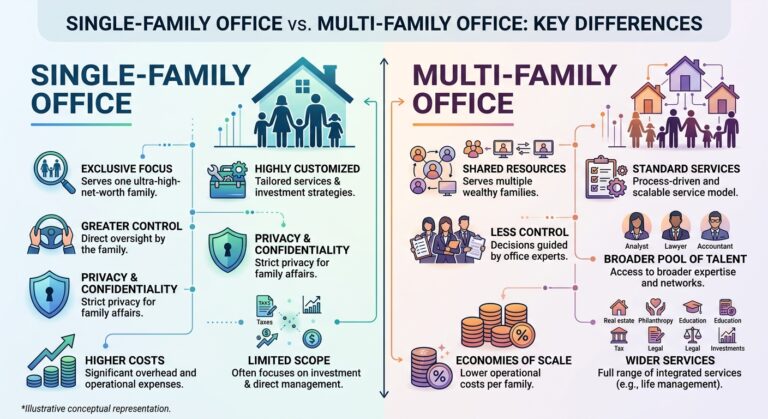
It’s worth noting that smaller single-family offices and most multi-family offices don’t provide every service on this list — lifestyle/concierge support in particular is often the first thing cut to control costs. Families evaluating a family office (or deciding whether to build one) should treat this list as a menu to prioritize, not a universal standard.
The Bottom Line
A family office’s real value isn’t any single service — it’s the coordination between all of them. Investment returns matter, but so does making sure tax strategy, estate planning, and philanthropy are all working toward the same long-term goals rather than operating in disconnected silos.