
Family Office vs. Private Bank: Which is Right for You?
Family office vs private bank: which is right for you? Compare fees, independence, investment choice, personalization, and services for wealthy families, and learn when a private bank is enough and when a family office is better.
The family office vs private bank decision comes down to one question: do you want a financial institution that offers products, or a team that works only for you? Both can manage large fortunes, but they earn money in different ways, owe you different legal duties and serve different needs. This guide compares them side by side, explains where each one wins and gives you a way to choose.
A note on sources: several of the comparisons below come from multi-family offices, which compete with banks for clients, so they have a commercial interest. Where that matters, the text says so. For the basics of the family model, see our guide to what a family office is and how it works.
Quick Answer: Family Office vs Private Bank
| Question | Family office | Private bank |
|---|---|---|
| Main role | Coordinates the family’s whole financial life | Manages investments, lending and cash |
| Who it works for | One family (single-family) or several (multi-family) | Itself and its clients, as part of a larger institution |
| How it earns money | Usually fees paid by the family | Fees plus commissions, lending, custody and product revenue |
| Legal standard | Often fiduciary | Often suitability, though models vary |
| Product choice | Wide, in principle unrestricted | Often favors the bank’s own products |
| Typical entry point | About $25 million (shared) to $100 million or more (private) | Set by each bank |
Family Office vs Private Bank: What Is a Private Bank?
A private bank is the wealth division of a larger financial institution. It manages portfolios, extends credit and handles cash and custody for wealthy clients. Cresset says private banks focus primarily on portfolio management, lending and cash management, with limited services beyond those. Many are excellent at what they do, and for families with straightforward needs that may be enough.
What Is a Family Office?
A family office is a dedicated organization that handles a family’s investments, tax, legal, estate, philanthropy and administrative affairs under one roof. It can be built for a single family or shared by several, as explained in our comparison of single-family and multi-family offices. Cresset lists tax, estate, philanthropy, concierge and governance services alongside investment management as the typical scope.
Family Office vs Private Bank: The Key Differences
1. Scope of Services
In the family office vs private bank comparison, the bank covers the financial plumbing. The family office covers the family. In the Cresset comparison, a family office adds tax, estate, philanthropy, lifestyle and governance work to the investment mandate. If your difficulty is coordination rather than returns, that breadth is the main attraction. Our guide to family office services details each area.
2. How Each One Gets Paid
Cresset describes the typical family office as fee-only: one revenue source and no commissions. It contrasts this with private banks that can draw revenue from commissions, markups, custodial fees, revenue sharing and 12b-1 fees, which it says creates potential conflicts. WE Family Offices makes a similar point, saying a multi-family office earns advisory fees, usually a retainer or a percentage of assets under advisement, and sells no products, while a private bank can earn from proprietary funds, commissions, lending and custody.
Because both firms are multi-family offices, read this as the offices’ own view. It still gives you the right questions to ask any bank: how is each recommendation paid for, and who benefits if you say yes?
3. Legal Standard of Care
Cresset says many family offices operate as fiduciaries, legally bound to act in the client’s best interest, while private banks must meet a suitability standard, meaning a recommendation need only be appropriate. WE Family Offices adds a nuance: banks may operate under suitability or hybrid models with mixed fiduciary status. The practical step is to ask any provider, in writing, which standard applies to the advice you will receive.
4. Independence and Product Access
Cresset says a family office can select from a broader array of options, while private banks primarily recommend their own products. WE Family Offices describes a multi-family office as an independent entity, not affiliated with banks or brokerages, whose investment committee can recommend any manager or service provider. A bank sits inside a larger institution and, according to WE, has an incentive to retain assets within it.
5. Control and Customization
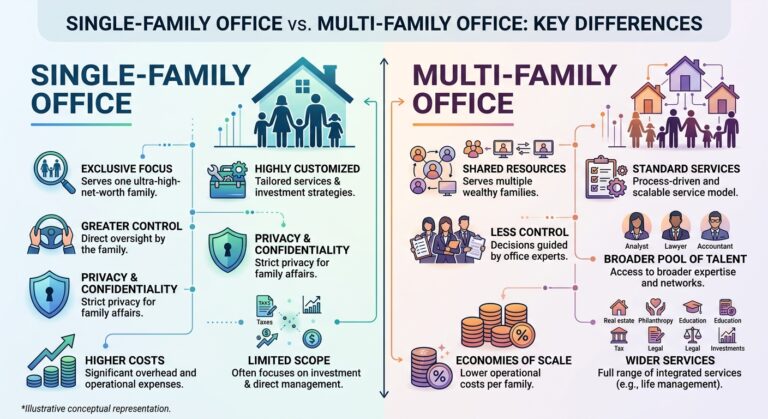
A single-family office gives the most control, since it is built around one family’s priorities. A private bank gives the least, because it offers a standard menu. A multi-family office sits in between. Our review of multi-family office pros and cons covers that middle path.
Side-by-Side Comparison Table
| Feature | Single-family office | Multi-family office | Private bank |
|---|---|---|---|
| Services | Fully tailored | Broad, standardized | Mainly banking and investing |
| Revenue model | Family funds all costs | Client fees, often a percentage of assets | Fees plus other revenue streams |
| Fiduciary duty | Depends on structure | Often registered advisers | Often suitability |
| Product bias | None by design | Low if fee-only | Higher risk of proprietary products |
| Privacy | Highest | Good | Good, within a large institution |
| Cost | Highest | Moderate | Varies by bank |
| Best for | Very large, complex fortunes | Families wanting breadth at shared cost | Simple needs, lending, convenience |
Family Office vs Private Bank Cost: What You Pay for Each Option
Private bank pricing varies by institution, so ask for a complete schedule. For the office models there are published benchmarks.
| Source | Figure |
|---|---|
| Morgan Lewis (July 2026) | Typical single-family office cost of about $875,000 a year under $250 million, $1.7 million for $250 million to $500 million, $3.2 million for $500 million to $1 billion and $6.6 million above $1 billion |
| Brown Brothers Harriman (BBH) | Single-family office running cost modeled at 0.40% to 0.70% of assets |
| WE Family Offices | Multi-family office clients typically hold $50 million or more in investable assets |
BBH adds that a family with $50 million or $100 million can likely receive most of the same services for less through a multi-family office, which benefits from scale, although multi-family fees are also meant to create a profit. Our guide to family office fees explains the pricing models in detail.
Family Office vs Private Bank: When the Bank Wins
A bank can be the right answer when the following hold.
- Your wealth is below the point where a shared office is practical. Morgan Lewis places multi-family office suitability from about $25 million.
- Your needs center on investing, borrowing and cash management.
- You value a single large institution with global reach.
- You already have a trusted tax advisor and attorney.
Banks also provide lending, which is often a deciding factor for entrepreneurs who borrow against their portfolios.
Family Office vs Private Bank: When the Office Wins
The family office vs private bank scales tip toward the office when these conditions apply.
- You hold substantial wealth. Morgan Lewis cites about $100 million to $250 million for a private office and $25 million to $150 million for a shared one.
- Your life involves several entities, countries, generations or an operating company.
- You want advice free of product sales.
- You want a single view of everything you own.
Morgan Lewis calls the model decision “not primarily a cost decision, but rather a governance and complexity decision.” That framing applies equally to the bank question: complexity, not only net worth, is what justifies a dedicated team.
Can You Use Both?
Yes, and many families do. A family office often keeps banking relationships for custody, lending and execution, and it picks the best institutions for each task. Using a bank for what it does well while a family office coordinates the whole picture is a common arrangement. In that model the bank becomes a service provider, not the center of the plan.
How Mature Is the Family Office Model?
Large offices are professionalizing. UBS’s 2026 Global Family Office Report, based on 307 family offices with an average net worth of $2.7 billion, found that 68% have formal financial performance measurement and 60% have an investment committee, though only 35% have a succession plan for the office itself. The lesson for a family choosing between a bank and an office is that a dedicated structure only helps if it comes with governance. Our article on how to start a family office covers the steps.
How to Decide Between a Family Office vs Private Bank: A Five-Question Test
- How much do you hold? Below roughly $25 million, a bank plus independent advisors is usually the practical option.
- How complex is your life? Count entities, countries, generations and businesses.
- How do you want advice paid for? Decide whether you want fee-only or are comfortable with product-based revenue.
- How much control do you want? The more you want, the closer you move to a dedicated office.
- Can you afford the structure? Compare the full annual cost with your assets and with the services you will actually use.
Common Mistakes in the Family Office vs Private Bank Decision
- Assuming a bank cannot be fiduciary. Standards vary, so verify.
- Assuming a family office is automatically conflict-free. Even fee-only firms can have conflicts, so review their disclosures, such as Form ADV for registered advisers.
- Choosing on prestige. Match the structure to your needs, not to a brand.
- Ignoring the total cost. Add up every fee on both sides.
- Treating it as permanent. Morgan Lewis advises revisiting the model every three to five years or after a major event.
Frequently Asked Questions
What is the main difference in the family office vs private bank choice?
A private bank offers banking and investment products as part of a larger institution, while a family office coordinates the family’s entire financial life and usually earns fees from the family rather than from products.
Is a family office better than a private bank?
Not for everyone. A family office suits complex, larger fortunes that want independence and broad coordination. A bank suits simpler needs and families who value lending and convenience.
Are family offices fiduciaries and private banks not?
Cresset says many family offices are fiduciaries and private banks follow a suitability standard, but WE Family Offices notes that banks may use hybrid models. Always confirm the standard in writing.
How much money do you need for a family office vs a private bank?
A multi-family office is often available from about $25 million, according to Morgan Lewis, while a private office is usually cited from $100 million to $250 million. Private bank minimums are set by each bank.
Can I keep my private bank and hire a family office?
Yes. Many families keep bank accounts for custody and lending while the office coordinates strategy.
Which is cheaper, a family office or a private bank?
It depends on your assets and the services you use. BBH says a family with $50 million or $100 million can likely get most of the services for less through a multi-family office than by building a private one.
This text is general information, not personalized financial, legal or tax guidance. Terms and rules differ by provider and country, so verify fees and fiduciary status with qualified professionals before you decide.
Sources
UBS, Global Family Office Report 2026 (media release, May 28, 2026) – https://www.ubs.com/global/en/media/display-page-ndp/en-20260528-global-family-office-report-2026.html
Cresset, “Family Office vs. Private Bank: A Guide for Entrepreneurs” (May 28, 2026) – https://cressetcapital.com/articles/insights/family-office-vs-private-bank/
WE Family Offices, “What Is a Multi-Family Office and How Is It Different From a Private Bank?” (May 14, 2026) – https://www.wefamilyoffices.com/resource/what-is-a-multi-family-office-and-how-is-it-different-from-a-private-bank/
Morgan Lewis, “Control, Cost and Complexity: Finding the Right Family Office Model” (July 2026) – https://www.morganlewis.com/pubs/2026/07/control-cost-and-complexity-finding-the-right-family-office-model
Brown Brothers Harriman, “Seven Considerations Before Creating a Family Office” (May 8, 2025) – https://www.bbh.com/us/en/insights/private-banking-insights/seven-considerations-before-creating-a-family-office.html