
Family Office Fees Explained: What They Really Cost
Family Office Fees Explained: What They Really Cost
One of the least understood aspects of family offices is how they’re actually paid for. Unlike a financial advisor charging a simple percentage of assets, family office costs vary wildly depending on structure, size, and services included. Here’s a realistic breakdown.
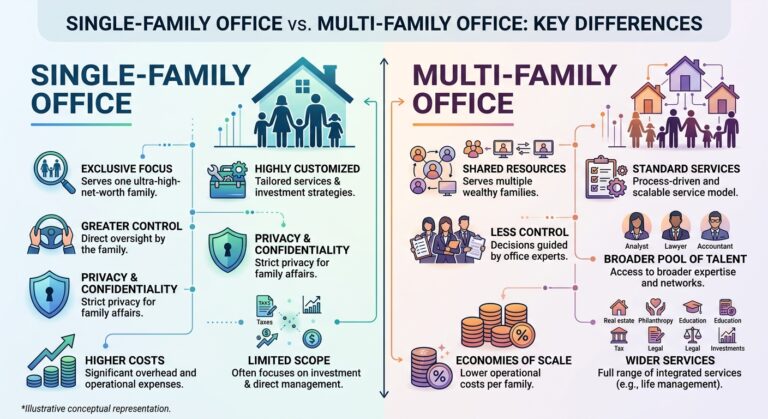
Single-Family Office Costs
A single-family office is funded directly by the family — there’s no external «fee» in the traditional sense, just an operating budget the family covers each year. Typical annual costs include:
- Total operating budget: $2–5 million per year for a lean office managing $150–300 million in assets; costs scale up from there for larger, more complex operations
- Chief Investment Officer: $300,000–$1,000,000+ in total compensation
- General Counsel / COO: $200,000–$500,000+
- Support staff (accountants, analysts, admin): $500,000–$1,500,000+ combined
- Technology, reporting, and infrastructure: $100,000–$300,000+
- Office space and overhead: Varies widely by location
As a rule of thumb, total costs typically run 0.5%–1% of assets under management for a well-run single-family office — below that ratio, quality of service tends to suffer; above it, the family is likely overpaying relative to a multi-family office alternative.
Multi-Family Office Fees
Multi-family offices charge in a way that’s more familiar to most investors — a percentage of assets under management, often on a sliding scale:
- Typical range: 0.25%–1% of AUM annually, decreasing as assets grow
- Flat retainer models: Some MFOs charge a flat annual fee (often $50,000–$250,000+) instead of a percentage, particularly for family governance or tax-only engagements
- À la carte services: Estate planning, tax filing, or philanthropic consulting are sometimes billed separately from core investment management
What Drives Costs Higher
Several factors push family office costs up regardless of structure:
- International complexity — multiple jurisdictions mean more legal and tax coordination
- Operating businesses — active family businesses require far more hands-on oversight than a pure investment portfolio
- Philanthropic operations — running a private foundation adds compliance and administrative overhead
- Multi-generational governance — more family members involved means more communication, reporting, and conflict management
Is It Worth the Cost?
For families below the ~$100 million threshold, the math rarely favors a single-family office — the fixed costs simply don’t scale down. For families well above that threshold, the cost is often justified by the combination of investment performance, tax efficiency, and the intangible value of privacy and control that a dedicated team provides.
The Bottom Line
There’s no universal price tag for a family office — costs depend entirely on structure, complexity, and scale. The key benchmark to remember: a well-run single-family office should cost roughly 0.5%–1% of assets annually, and if a family’s actual costs are running meaningfully above that, it’s usually a sign the structure has outgrown its efficiency or needs a review.