
How Much Money Do You Need to Start a Family Office?
How Much Money Do You Need to Start a Family Office?
It’s one of the most common questions people ask once they understand what a family office actually does: «What’s the number?» How much wealth does a family actually need before setting up its own private office makes financial sense?
There’s no official threshold — no regulator sets a minimum — but industry practice, and simple math, give a fairly clear answer.
The Short Answer
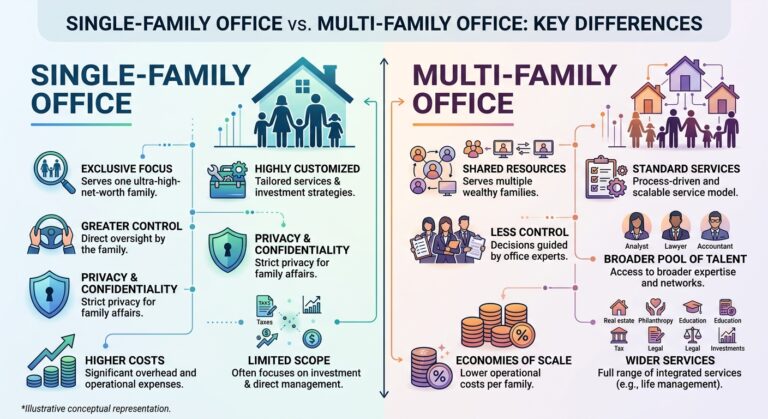
Most wealth advisors put the practical minimum for a single-family office somewhere between $100 million and $250 million in investable assets. Below that range, the fixed costs of running a dedicated team typically outweigh the benefits compared to using a multi-family office or a top-tier private bank.
For a multi-family office, the entry point is much lower — often starting around $10–30 million, since costs are shared across several client families.
Why the Number Is So High for a Single-Family Office
Running a single-family office isn’t a part-time hire — it’s building an entire private institution. Typical annual operating costs include:
- Investment staff: A Chief Investment Officer alone can command $300,000–$1,000,000+ per year in total compensation, depending on experience and assets managed
- Legal and tax counsel: Either in-house or heavily retained outside counsel, easily $200,000–$500,000+ per year
- Operations and administrative staff: Accountants, office managers, executive assistants
- Technology and reporting systems: Portfolio management software, secure reporting platforms, cybersecurity
- Office space and overhead: Even a lean single-family office typically runs $2–5 million per year in total costs
The general rule of thumb used across the industry: a single-family office’s annual operating cost should stay below roughly 0.5%–1% of total assets under management. Run the math backward, and $2–5 million in annual costs only makes sense once you’re managing at least $100–250 million — otherwise the overhead ratio becomes disproportionate compared to simply paying a percentage-based fee to an outside firm.
What If You Have Less Than $100 Million?
This is where most wealthy families — even genuinely wealthy ones — actually land. Below the single-family office threshold, two paths make more sense:
A multi-family office. You get many of the same services (investment management, tax coordination, estate planning) at a fraction of the cost, because the fixed overhead is shared across multiple client families. Fees are typically charged as a percentage of assets, often in the 0.25%–1% range depending on services included.
A private bank or independent wealth management firm. For families closer to $10–30 million, a strong private banking relationship combined with independent legal and tax advisors can cover most of the same ground, just without the «family office» branding or the lifestyle/concierge services.
When Does It Actually Make Sense to Cross the Threshold?
Wealth level alone isn’t the only factor. Families often justify building a single-family office earlier than the $100M mark when:
- Wealth is tied up in a complex operating business requiring dedicated oversight
- The family has significant assets across multiple countries or currencies, creating complicated tax and legal needs
- Privacy is a very high priority (public figures, high-profile business owners)
- The family plans to actively manage philanthropic giving through a dedicated foundation
- There’s a strong desire to keep control fully in-house rather than sharing an advisory team with other families
The Bottom Line
There’s no hard rule, but the economics are clear: below roughly $100 million, a dedicated single-family office rarely pays for itself. Most families in the $10–100 million range are far better served by a multi-family office, which delivers similar expertise and service quality without the overhead of building an entire private institution from scratch.