
Athlete Family Office: How Celebrities and Athletes Use Family Offices
Athlete family office guide: see how celebrities and professional athletes protect short careers and large earnings through wealth management, investment diversification, estate planning, insurance, privacy, and lifestyle services tailored to public figures.
An athlete family office is a private organization that manages the money, taxes, contracts, brand and investments of a professional athlete or entertainer. The reason it exists is simple. Large sums arrive quickly, from many directions and often in a person’s twenties, while the earning window can be short. This guide explains why celebrities and athletes build family offices, what those offices do, how well-known stars structure theirs and what ordinary families can learn from the model.
Quick Answer: How Do Celebrities and Athletes Use Family Offices?
- To manage a short earning window. Advisor Perspectives says players in major leagues average about five years of playing careers.
- To handle complex income and taxes. Salaries, bonuses, endorsements and licensing create multiple tax forms and returns in several states.
- To protect assets and image rights. Insurance, trusts and control of name, image and likeness (NIL) rights sit at the center of planning.
- To build businesses beyond the sport. Many stars run a venture fund, a media company and a foundation under one roof.
- To turn fame into ownership. Profluence describes the goal as ownership across several revenue streams, instead of relying only on endorsements.
Why Athletes and Celebrities Need a Family Office
A Short Window to Earn
Advisor Perspectives reports that players in the NBA, NFL, MLB, NHL, NWSL and WNBA average roughly five years of playing careers. That means a lifetime of spending must be funded by a handful of seasons, so planning has to begin on day one. The same article lists short-career planning as the first of five core areas of athlete wealth planning.
Complicated Income and Taxes
Athlete income comes from many sources: salaries, bonuses, endorsements, licensing and passive investments. Advisor Perspectives notes that these generate multiple 1099s, W-2s and K-1s. Federal rates reach up to 37% and state taxes range from 0% to 14.4%. The so-called jock tax can require 8 to 25 separate tax returns a year, depending on the sport, because athletes pay tax in each state where they play.
A family office coordinates accountants, tax advisors and lawyers so that nothing is missed.
Sudden Wealth at a Young Age
Managing a large inflow early in life is a challenge most people face much later. A dedicated team gives the athlete a single point of contact, a budget and a plan for the years after the career ends.
The Five Core Planning Areas for Athletes
Advisor Perspectives frames athlete planning around five areas.
| Planning area | What it covers |
|---|---|
| Short career planning | Strategies that account for a limited earning window |
| Tax optimization | Federal, state and jock tax planning |
| Income diversification | Managing salary, endorsements, licensing and passive income |
| Asset protection | Insurance for injury, life, disability and bonuses, plus legal structures |
| Legacy planning | Wills, trusts and protection of NIL rights beyond the career |
What Does an Athlete Family Office Do?
AndSimple lists the typical components of a family office for athletes.
| Service | What it does |
|---|---|
| Financial planning | Builds diversified portfolios of stocks, real estate and tech startups |
| Tax and legal services | Manages multi-jurisdictional income and compliance |
| Brand management | Protects intellectual property and negotiates endorsement deals |
| Estate planning | Structures wealth transfer across generations |
| Risk management | Arranges insurance and disability protection |
AndSimple adds that sports agents and family office advisors can also provide investment diversification, tax optimization, lifestyle management and guidance through the move from playing career to retirement.
How Stars Structure Their Offices: Real Examples
LeBron James: LRMR Ventures and Beyond
AndSimple describes LRMR Ventures as a family office co-founded by LeBron James that combines brand building, venture capital and community empowerment, with investments in sports nutrition and real estate. Profluence uses his group as the model of a full athlete family office, citing the in-house agency Klutch Sports, the venture fund LRMR Ventures and the media company SpringHill Entertainment.
Serena Williams: Serena Ventures
AndSimple notes that Serena Williams created Serena Ventures, a venture firm focused on early-stage companies led by women and people of color. It shows how an office can express personal values while building a legacy beyond sport.
Alex Rodriguez: A-Rod Corp
The same source describes A-Rod Corp as a hands-on investment operation spanning real estate, entertainment and wellness, using the former baseball star’s expertise and public profile.
The Five-Part Athlete Family Office Model
Profluence breaks the athlete family office into five components.
| Component | Purpose |
|---|---|
| Agency | In-house representation, as with Klutch Sports |
| Venture fund | Private equity, startups and real estate, as with LRMR Ventures |
| Advisory board | Trusted business partners and advisors |
| Charitable foundation | Philanthropic work |
| Media and production arm | Control over content and storytelling, as with SpringHill Entertainment |
Profluence says the model creates ownership across revenue streams, lets athletes tell their own stories and offers tax advantages through integrated businesses. It also states plainly that it takes extreme wealth, fame and influence to do this, which is why only a select handful of athletes can.
Athlete Family Offices as Sports Investors
Athletes and family offices are also moving into sports ownership. Dakota’s 2026 roundup says family offices wrote some of the biggest checks in sports this spring, shifting from passive fund investing to direct capital in franchises and platforms.
| Investor (as listed by Dakota) | Deal |
|---|---|
| Kwanza Jones and José E. Feliciano | Controlling stake in the San Diego Padres, about $3.9 billion |
| Mark Cuban | Harbinger Sports Partners |
| Drake | Co-owner of Venezia FC |
| David Blitzer (Bolt Ventures) | Hurricane Junior Golf Tour |
For a family office, sports assets offer a combination of brand, passion and long-term growth. They also concentrate risk in a single industry, so they should be sized within an overall plan.
Asset Protection and Legacy for Public Figures
For public figures, the name and income are the assets most worth protecting. Advisor Perspectives highlights insurance for injury, life, disability and bonuses, along with legal structures that safeguard wealth. It also stresses legacy tools: wills, trusts and protection of name, image and likeness rights that extend beyond the career and even beyond the athlete’s lifetime.
Do You Need a Full Family Office? Options for Athletes and Celebrities
Profluence notes that only a handful of athletes can sustain a full structure. Most do not need one, and the sources do not give cost figures for these offices. A staged approach is more realistic.
| Stage | Typical setup |
|---|---|
| Early career | A trusted financial advisor, an accountant familiar with multistate taxes and adequate insurance |
| Growing income | Add a tax specialist, an estate attorney and a business manager |
| Large and complex wealth | A virtual or multi-family office that coordinates the team |
| Very large wealth and a brand | A dedicated single-family office with ventures, media and a foundation |
Lessons Any Family Can Take From the Athlete Model
- Plan for the shortest income window, not the best case.
- Separate lifestyle spending from invested capital. Set a budget early.
- Protect the downside with insurance before chasing upside.
- Treat your name and image as assets, and protect them legally.
- Build a team with defined roles rather than relying on one advisor.
- Diversify beyond the activity that created the wealth.
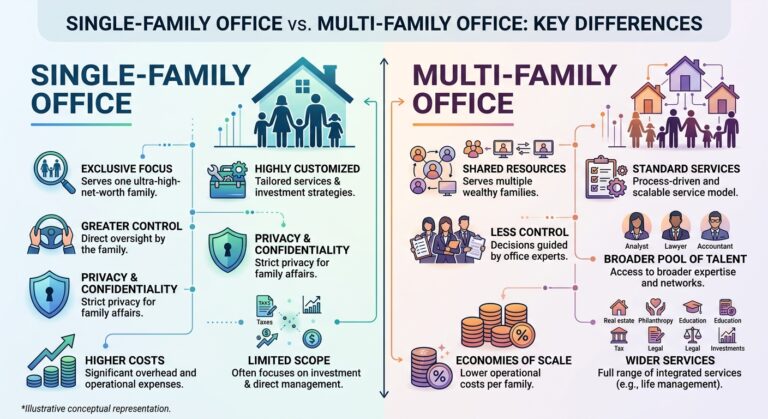
Athlete Family Office vs. a Traditional Family Office
The two models share a goal, protecting and growing wealth, but their starting points differ.
| Feature | Athlete family office | Traditional family office |
|---|---|---|
| Source of wealth | Salary, endorsements, licensing and a personal brand | Often a family business, a sale or inherited assets |
| Time horizon | Built around a short earning window | Often multi-generational from the start |
| Extra functions | Agency, media arm, brand and NIL management | Investment, tax, legal and governance focus |
| Tax complexity | Multistate and jock tax filings | Depends on entities and countries involved |
| Key person risk | Very high, because the athlete is the brand | Spread across family members and staff |
How an Athlete Builds a Family Office Step by Step
- Start with protection. Put insurance for injury, life, disability and bonuses in place early, as Advisor Perspectives recommends.
- Map every income stream. List salary, bonuses, endorsements, licensing and passive income, along with the tax forms each one creates.
- Assemble the core team. Combine a financial advisor, a multistate tax specialist, an estate attorney and a business manager.
- Create separate entities. Keep the athlete’s personal assets apart from business ventures and investments.
- Define the brand strategy. Decide how name, image and likeness rights will be licensed and protected.
- Add ventures gradually. Move into a venture fund, media or other businesses once the foundation is stable.
- Plan the transition. Write down what life and income look like after the playing career ends, and review the plan every year.
Common Mistakes
- Mixing business and personal money. Keep entities and accounts separate.
- Ignoring multistate tax rules. The jock tax can multiply filings.
- Skipping insurance. An injury can end a career overnight.
- Following every investment pitch. Use an advisory board or committee to test ideas.
- Forgetting life after sport. Plan the transition before it arrives.
Frequently Asked Questions
What is an athlete family office?
It is a private organization that manages an athlete’s finances, taxes, brand, ventures and legacy. Profluence describes it as consolidating business operations under one structure so the athlete keeps control and builds generational wealth.
Why do athletes need a family office?
Careers are short, income is complex and taxes are spread across states. Advisor Perspectives says major league players average about five years of playing careers.
What is the jock tax?
It is the tax professional athletes pay in each state where they play. Advisor Perspectives says it can require 8 to 25 separate returns a year depending on the sport.
Which athletes have family offices?
AndSimple cites LeBron James with LRMR Ventures, Serena Williams with Serena Ventures and Alex Rodriguez with A-Rod Corp.
What services does an athlete family office provide?
Typical services include financial planning, tax and legal support, brand management, estate planning and risk management, according to AndSimple.
Can a normal athlete afford a family office?
Few can sustain a full one. Many start with a good advisor and accountant and add services as income grows.
This article is general information, not legal, tax or financial advice. Examples are drawn from public sources and do not imply endorsement. Consult qualified professionals before structuring your own affairs.
Sources
- Advisor Perspectives, “Wealth Planning in a League of Its Own: Guidance for Professional Athletes” (May 27, 2025) – https://www.advisorperspectives.com/articles/2025/05/27/wealth-planning-league-own-guidance-professional-athletes
- AndSimple, “Structuring Success: How US Sporting Celebrities Manage Their Family Offices” (February 22, 2024) – https://andsimple.co/insights/how-us-sporting-celebrities-manage-their-family-offices
- Profluence, “The Athlete Family Office” – https://profluence.com/the-athlete-family-office/
- Dakota, “Top 10 Family Offices and Private Wealth Investors Backing Sports Deals in 2026” – https://www.dakota.com/resources/blog/top-10-family-offices-and-private-wealth-investors-backing-sports-deals-in-2026